quarta-feira, 22 de julho de 2015

Imigração América

37 maps that explain how America is a nation of immigrants

American politicians, and Americans themselves, love to call themselves "a nation of immigrants": a place where everyone's family has, at some point, chosen to come to seek freedom or a better life. America has managed to maintain that self-image through the forced migration of millions of African slaves, restrictive immigration laws based on fears of "inferior" races, and nativist movements that encouraged immigrants to assimilate or simply leave.
Mais

Século 19

7 razões porque você odiaria viver no século 19

Talvez você ainda não tenha se tocado disso, mas há centenas de escravos trabalhando para você. Sim, isso mesmo que você leu: centenas de escravos. Todos os dias, de domingo a domingo.
Repare como é o seu dia. Você acorda esticado num lençol de tecido chinês, assiste a seu seriado favorito num televisor com partes eletrônicas de Taiwan e da Coreia do Sul, dirige um carro provavelmente alemão, japonês ou italiano, conversa num celular com plástico tailandês e borracha malaia, troca emails através de um servidor americano e agora provavelmente está lendo esse texto por uma tela de led fabricada em Cingapura. E isso é apenas a ponta do iceberg. Em poucos minutos, você consome produtos dos mais remotos cantos do mundo, que movimentam um batalhão de seres humanos, atravessando oceanos, rompendo barreiras, com um único propósito: servi-lo. Há pessoas extraindo petróleo por você, cultivando alimentos, desenvolvendo medicações, softwares, obras culturais. Talvez você sequer tenha percebido tudo isso, mas consome frações do trabalho de centenas de pessoas, das mais diversas nacionalidades, todos os dias.

terça-feira, 21 de julho de 2015

Baixar a idade para tomar alcool

Lower the Drinking Age! 

The law is causing worse problems than it solves - by 

It’s rush time for fraternities and sororities on college campuses right now. That means dressing up, networking, socializing, attending parties, and staying up late nights. It also means, whether parents know it (or like it) or not, astonishing amounts of drinking of very potent liquor. One of the most famous “drinks” is called “jungle juice”: trash barrels filled with random spirits and mixtures, consumed one red cup at a time.
Many of these kids are away from home for the first time, able to drink to their heart’s content. A huge culture as grown up around this practice, including a full vocabulary, games, and rituals. Mostly it is just fun, but it can also lead to serious trouble for everyone involved. Let’s not be squeamish: it leads to very un-adult-like amounts of personal abuse and, often, the abuse of others.
Most of these kids have never been socialized in what it means to drink responsibly. They are living for the thrill that comes with defiance. The combination of new freedom, liquor, and sexual opportunity leads to potentially damaged lives.
Mais

O mito da "guerra civil" americano

Historical Truth

We call the war of 1861 the Civil War. But is that right? A civil war is a struggle between two or more entities trying to take over the central government. Confederate President Jefferson Davis no more sought to take over Washington, D.C., than George Washington sought to take over London in 1776. Both wars, those of 1776 and 1861, were wars of independence. Such a recognition does not require one to sanction the horrors of slavery. We might ask, How much of the war was about slavery?
Mais

Efeito ecologico do petroleo

Petrol power: an eco-revolution

The rise of petroleum-powered transport was an environmental boon.
Apart from their stench, urban stables and the manure piles that filled practically every vacant lot were prime breeding grounds for house flies, perhaps three billion of which hatched each day in American cities at the turn of the twentieth century. With flies came outbreaks of deadly infectious diseases, such as typhoid and yellow fever, cholera and diphtheria. Workhorses’ skittishness in heavy traffic also meant that they stampeded, kicked, bit and trampled a number of bystanders. According to one estimate, the fatality rate per capita in urban traffic was roughly 75 per cent higher in the horse era than today. The clatter of horseshoes and wagon wheels on cobblestone pavement was also incredibly noisy. They also created significant traffic congestion, because a horse and wagon occupied more street space than a modern truck, while a badly injured horse would typically be shot on the spot or abandoned to die on the road, creating a major obstruction that was difficult to remove in an age without tow trucks. (Indeed, street cleaners often waited for the corpses to putrefy so they could be sawed into pieces and carted off with greater ease.)
Mais

Pobreza infantil

Report suggests US children left behind in economic recovery


Report on child welfare suggests many US children were left behind in economic recovery

segunda-feira, 20 de julho de 2015

Anti-Natalismo

We Are Creatures That Should Not Exist’: The Theory of Anti-Natalism

Sobre Adam Smith

adam smithIn the “Overture” to his grandly symphonic The Enlightenment: An Interpretation, Peter Gay describes the “international type” of the philosophe as a “facile, articulate, doctrinaire, sociable, secular man of letters.” On this definition, was Adam Smith a philosophe?
Yes and no. Unlike his French counterparts, and even his bosom friend David Hume, he led a retired life, much of it in the small Scottish town where he was born, and he lived with his mother until she died at a very advanced age. He was shy, destroyed most of his letters, and did not seem to relish giving brilliant performances, either in print or in conversation. He never fell afoul of civil or religious authority, had no mistresses, and engaged in no public quarrels.
(A semi-public one, though. Shortly after Hume’s death, Smith met Samuel Johnson at a party. Johnson spoke slightingly of Hume, Smith defended him, and their exchanges grew increasingly heated until Johnson exclaimed, “Sir, you lie!” To which Smith retorted, “Sir, you are the son of a whore!” and stalked out.)

O Heinsohn hiato

Working backwards through the mainstream historical narrative we arrive at the Heinsohn Horizon in the 930s where the mainstream narrative falls into The Academic Abyss and degenerates into fiction, fantasy and fabrication for a period of 700 [phantom] years.
Mainstream historians [and tributary catastrophists] clearly have their eyes wired shut and their index fingers firmly wedged into their ears as they chant: “I can’t hear you Heinsohn”.
Therefore, some 700 years of the 1st millennium (230 to 930s) have neither strata nor tree samples for C14 or dendro-chronological dating.
Archaeological Strata Versus Baillie’s Tree-Rings: Proposal for an Experiment
Gunnar Heinsohn – 8 September 2014
http://www.q-mag.org/_media/gunnar-strata-vsbaillie08-09-2014.pdf
http://www.q-mag.org/the-1st-millennium-a-d-chronology-controversy.html
The problem for many mainstream and tributary historians is that their professional lives are dedicated to filling The Academic Abyss with fiction, fantasy and fabrication.
Mais

Anti-Política

"Perhaps counterintuitively, there is an authoritarian critique of politics just as there is a libertarian one. For example, as political theory scholar David Held observes, Karl Marx looked forward to an “end of politics,” a world without political or economic classes, in which the “political supremacy” of the proletariat and the end of material scarcity would be realized. Ironically, Marx presents a vision in some ways quite similar to that of libertarians, treating politics as “the official expression of antagonism in civil society” and anticipating the dissipation of the state and the related growth of a new, different kind of governing system. Taking Marx’s stateless, anti-political reverie on its face, libertarians may be tempted to think that it doesn’t sound half bad. Who wouldn’t want a society without unjust, coercive class rule, where permanent material plenitude has replaced poverty and want? If only we could call a halt to the messy, obstructive, and—perhaps worst of all—corrupt process of politics, we might get on our way toward utopia. Inspirited by seemingly endless scientific advancements and technological developments, utopians of all kinds once confidently forecasted the day when society would be cleansed finally and fully of politics. In the United States, the authoritarian variety of this anti-political thinking reached its apogee during the Progressive Era. But while the progressives purported to be anti-political, they, like Marxists, were not anti-state; they sought not to replace or discard the state, but to purify it, to make it the instrument of the empirical method, of objective, scientific knowledge used to execute and administer a rational ordering of society from the top down. Specialization and expertise were in the ascendant, attended by a new contempt among intellectuals and elites for all things political and ideological. According to the progressive thinking, if everything is reducible to hard science—to empirical data, duly analyzed and quantified—then there is no longer a need for either politics or ideology. Trained experts in central government agencies, assigned to specific social problems and tasks, need only determine the correct, scientific solution and determine a plan for its implementation.
"The fundamental mistake of such thinking is one that Hayek identified in his Nobel Prize lecture, “The Pretence of Knowledge,” in which he explains the problems with applying the methods of the physical sciences to the social sciences. Progressivism is an example of this kind of “scientism,” an attempt to coopt, in Hayek’s words, “the dignity and prestige of the physical sciences” for public policy decisions made by a burgeoning class of bureaucrats—as opposed to either state legislatures or the U.S. Congress. The twentieth century academy likewise embraced the intellectual vainglory of scientism, the economics profession, for example, coming to treat economies as “engineerable systems, i.e., machines.”2 Many free market economists espoused this “modernist genre of economic theory,” even as they battled the ideas of Keynesianism and socialist economic planning. The space of thought, inquiry, and political debate was narrowing, giving way to a monotonous climate of conformity."
Mais

Protecionismo brasileiro

 Acordo elimina tarifas para eletrônicos em 80 países, mas Brasil resolve ficar fora - InfoMoney
Veja mais em: http://www.infomoney.com.br/minhas-financas/gadgets/noticia/4167900/acordo-elimina-tarifas-para-eletronicos-paises-mas-brasil-resolve-ficar

Conceitos básicos do libertarianismo

Com o que sonham os libertários


POR RONALD HILLBRECHT*

Conceitos centrais do libertarianismo começaram a tomar forma no século 17, com foco ora em direitos, ora em consequências

Libertarianismo é a filosofia política da liberdade. Seus conceitos centrais foram sendo desenvolvidos ao longo dos séculos e podem ser encontrados em textos antigos como o Tao Te Ching e a Bíblia. Entretanto, foi a partir dos séculos 17 e 18 que o ideal de liberdade começou a tomar forma como filosofia política por autores como John Locke, David Hume, Adam Smith, John Stuart Mill e Thomas Jefferson. Libertários acreditam que o respeito pela liberdade individual é o requisito central de justiça e que as relações humanas devem ser baseadas em consentimento mútuo. Eles advogam uma sociedade livre baseada em cooperação, tolerância e respeito mútuo. Libertários acreditam que todas as pessoas têm o direito de decidir os rumos das suas vidas e não podem ser forçadas a servir outros nem ser sacrificadas em nome de grandes ideais sociais. Desta forma, libertários enfatizam a dignidade de cada indivíduo, o que lhes confere tanto direitos quanto responsabilidades: adultos não devem ser tratados como escravos ou servos, nem como crianças. Algumas das maiores conquistas da humanidade, como a abolição da escravidão; o estabelecimento de tolerância religiosa; a progressiva extensão da dignidade às mulheres, gays e minorias étnicas e religiosas; a substituição da superstição pela ciência; a subordinação de monarcas a parlamentos eleitos; a proteção de direitos à propriedade para todos; a substituição do mercantilismo por mercados e a substituição de governos arbitrários pelos constitucionalmente limitados, estão todas intimamente vinculadas às ideias de liberdade e dignidade individual.
Mais

domingo, 19 de julho de 2015

Profissionais de pobeza

Jonet diz que há 'profissionais da pobreza em Portugal'

A presidente da Federação Europeia dos Bancos Alimentares, Isabel Jonet,  alertou ontem para a existência em Portugal de pessoas que fazem da mendicidade um modo de vida, referindo-se aos mesmo como “profissionais da pobreza”, lê-se no Jornal de Notícias. 

Derrubando os mitos sobre Revolução Francesa

Secher, Reynald: A French Genocide: The Vendee 
Furet, François: Interpreting the French Revolution
Schama, Simon: Citizens: A Chronicle of the French Revolution

sábado, 18 de julho de 2015

O mito da idade oscura

God's PhilosophersThe Dark Age Myth: An Atheist Reviews “God’s Philosophers”

by  
Filed under Book Reviews
My interest in Medieval science was substantially sparked by one book. Way back in 1991, when I was an impoverished and often starving post-graduate student at the University of Tasmania, I found a copy of Robert T. Gunther's Astrolabes of the World - 598 folio pages of meticulously catalogued Islamic, Medieval and Renaissance astrolabes with photos, diagrams, star lists and a wealth of other information. I found it, appropriately and not coincidentally, in Michael Sprod's Astrolabe Books - up the stairs in one of the beautiful old sandstone warehouses that line Salamanca Place on Hobart's waterfront. Unfortunately the book cost $200, which at that stage was the equivalent to what I lived on for a month. But Michael was used to selling books to poverty-stricken students, so I went without lunch, put down a deposit of $10 and came back weekly for several months to pay off as much as I could afford and eventually got to take it home, wrapped in brown paper in a way that only Hobart bookshops seem to bother with anymore. There are few pleasures greater than finally getting your hands on a book you've been wanting to own and read for a long time.
Mais

Efeitos da redistribuição

Nineteen Neglected Consequences of Income Redistribution

Virtually every government action changes the personal distribution of income, but some government programs, which give money, goods, or services to individuals who give nothing in exchange, represent income redistribution in its starkest form.
Until the twentieth century, American governments steered pretty clear of such “transfer payments.” The national government gave pensions and land grants to veterans, and local governments provided food and shelter to the destitute. But the transfers to veterans can be viewed as deferred payments for military services, and local relief never amounted to much.
Since the creation of the Social Security system in 1935, especially during the past 30 years, the amount of income overtly transferred by governments has risen dramatically. In 1960 government transfer payments to persons amounted to $29 billion, or 7 percent of personal income. In 1993 the total came to $912 billion, or nearly 17 percent of personal income.1 In other words, one dollar out of every six received as personal income now takes the form of old-age, survivors, disability, and health insurance benefits ($438 billion), unemployment insurance benefits ($34 billion), veterans’ benefits ($20 billion), government employees’ retirement benefits ($115 billion), aid to families with dependent children ($24 billion), and miscellaneous other government transfer payments ($280 billion) such as federal subsidies to farmers and state and local public assistance to poor people.
Mais

Educação contra instrução

Das Universelle Verblödungssystem
"Bildung ist etwas, was man ganz ohne Beeinträchtigung durch den Schulunterricht erwerben muss."
Mark Twain

"Wenn wir etwas lernen wollen, müssen wir bei Aktionen und Protesten mitmachen, das ist Selbstaufklärung durch Widerstand, und die brauchen wir auch, denn Presse und Universitäten informieren nicht über das, was wirklich passiert."
Maria Mies

"Was nützt es dem Menschen, wenn er Lesen und Schreiben gelernt hat,
 
aber das Denken anderen überlässt?"
Ernst R. Hauschka

"Weil Denken die schwerste Arbeit ist, die es gibt, beschäftigen sich auch nur wenige damit."
Henry Ford

"Der rastlose Arbeitsmensch von heute hat tagsüber keine Zeit, sich Gedanken zu machen - und abends ist er zu müde dazu. Alles in allem hält er das für Glück."
George Bernard Shaw

"Immer, wenn man die Meinung der Mehrheit teilt, ist es Zeit, sich zu besinnen."
Mark Twain

"Für einen intelligenten Menschen ist es Zeitverschwendung, der Mehrheit anzugehören. Per definition tun das schon genug Leute."
 
G.H. Hardy

"Auf seine eigene Art zu denken, ist nicht selbstsüchtig.
 
Wer nicht auf seine Art denkt, denkt überhaupt nicht."
Oscar Wilde

"Aufklärung ist der Ausgang des Menschen aus seiner selbstverschuldeten Unmündigkeit."
Immanuel Kant

"Über eine gewonnene Erkenntnis sollte man sich mehr freuen als über eine verlorene Illusion."
Horst Friedrich

"Die Leute sind gar nicht so dumm, wie wir sie durch das Fernsehen noch machen werden."
Hans Joachim Kulenkampff

"Der Mensch hat dreierlei Wege klug zu handeln: erstens durch nachdenken,
 
das ist der edelste, zweitens durch nachahmen, das ist der leichteste,
 
und drittens durch Erfahrung, das ist der bitterste."
Konfuzius

"Wenige sind imstande, von den Vorurteilen der Umgebung abweichende Meinungen gelassen auszusprechen, die meisten sind sogar unfähig, überhaupt zu solchen Meinungen zu gelangen."
Albert Einstein

"Glaubt den Büchern nicht, glaubt den Lehrern nicht, glaubt auch mir nicht.
Glaubt nur das, was ihr selbst sorgfältig geprüft und als Euch selbst
und anderen zum Wohle dienend erkannt habt."
Buddha

Mau Mau

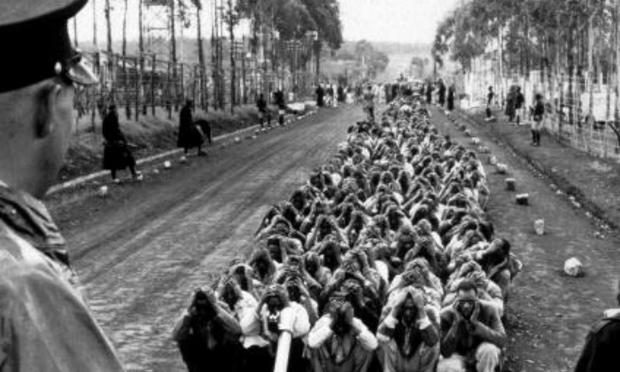
Mau Mau detainees (Getty Images/Getty)
This is the story of a few documents that tumbled out of the secret archives of the biggest empire the world has ever known, offering a glimpse of histories waiting to be rewritten.
When professor Caroline Elkins came across a stray document left by the British colonial government in Nairobi, Kenya, she opened the door to a new reckoning with the history of one of Britain's colonial crown jewels, and the fearsome group of rebels known as the Mau Mau.
Mais

O lado escuro do Churchill

Not his finest hour: The dark side of Winston Churchill 

Winston Churchill is rightly remembered for leading Britain through her finest hour – but what if he also led the country through her most shameful hour? What if, in addition to rousing a nation to save the world from the Nazis, he fought for a raw white supremacism and a concentration camp network of his own? This question burns through Richard Toye's new history, Churchill's Empire, and is even seeping into the Oval Office.
George W Bush left a bust of Churchill near his desk in the White House, in an attempt to associate himself with the war leader's heroic stand against fascism. Barack Obama had it returned to Britain. It's not hard to guess why: his Kenyan grandfather, Hussein Onyango Obama, was imprisoned without trial for two years and was tortured on Churchill's watch, for resisting Churchill's empire.
Mais

Churchill e Índia

How Churchill 'starved' India

Soutik Biswas | 15:50 UK time, Thursday, 28 October 2010
Victims of the famine in Bengal, 1943
It is 1943, the peak of the Second World War. The place is London. The British War Cabinet is holding meetings on a famine sweeping its troubled colony, India. Millions of natives mainly in eastern Bengal, are starving. Leopold Amery, secretary of state for India, and Field Marshal Sir Archibald Wavell, soon to be appointed the new viceroy of India, are deliberating how to ship more food to the colony. But the irascible Prime Minister Winston Churchill is coming in their way...
Some three million Indians died in the famine of 1943. The majority of the deaths were in Bengal. In a shocking new book, Churchill's Secret War, journalist Madhusree Mukherjee blames Mr Churchill's policies for being largely responsible for one of the worst famines in India's history. It is a gripping and scholarly investigation into what must count as one of the most shameful chapters in the history of the Empire.
Mais

sexta-feira, 17 de julho de 2015

Riqueza facil

 Want to join the 1%? Nothing is stopping you 

Constant churn of capitalism creates lots of class mobility

StevenHorwitz


Critics of the ”1%” frequently speak of them as if they were a modern aristocracy. Yet one of the great myths about income inequality in the U.S. is that the people who are in the top 20%, or even the top 1%, remain the same from year to year or even generation to generation.
The reality is that Americans move out of poverty and fall from wealth because market economies are always churning, rewarding those who deliver value in a free market, and penalizing those who don’t. America continues to be the land of opportunity. Anyone can join the 1%.
What economists call income mobility continues in this country over the course of any individual’s lifetime and across generations. Being poor at any specific point in time, or being the child of poor parents, does not mean people are unable to move up the income ladder. In the same way, there is no guarantee that those at the top will stay there. 
Mais

Você é mais rico que pensa

You’re Richer Than You Think. Really.

The Fiscal Times

This little exercise might make you feel a bit better about your standing in the world. As part of a huge study on the state of the global middle class, the Pew Research Center has created a new tool that lets you see how your income stacks up with that of households worldwide.
To find out, just enter your country, the number of people in your household, and your annual, weekly, or monthly income into the calculator below. (Pew says it doesn’t store or share any of the data you enter.)

quinta-feira, 16 de julho de 2015

Vício

What really causes addiction — to everything from cocaine to smart-phones? And how can we overcome it? Johann Hari has seen our current methods fail firsthand, as he has watched loved ones struggle to manage their addictions. He started to wonder why we treat addicts the way we do — and if there might be a better way. As he shares in this deeply personal talk, his questions took him around the world, and unearthed some surprising and hopeful ways of thinking about an age-old problem.

TEDTalks is a daily video podcast of the best talks and performances from the TED Conference, where the world's leading thinkers and doers give the talk of their lives in 18 minutes (or less). Look for talks on Technology, Entertainment and Design -- plus science, business, global issues, the arts and much more.
Find closed captions and translated subtitles in many languages at http://www.ted.com/translate

Desigualdade

Some measures are more equal than others


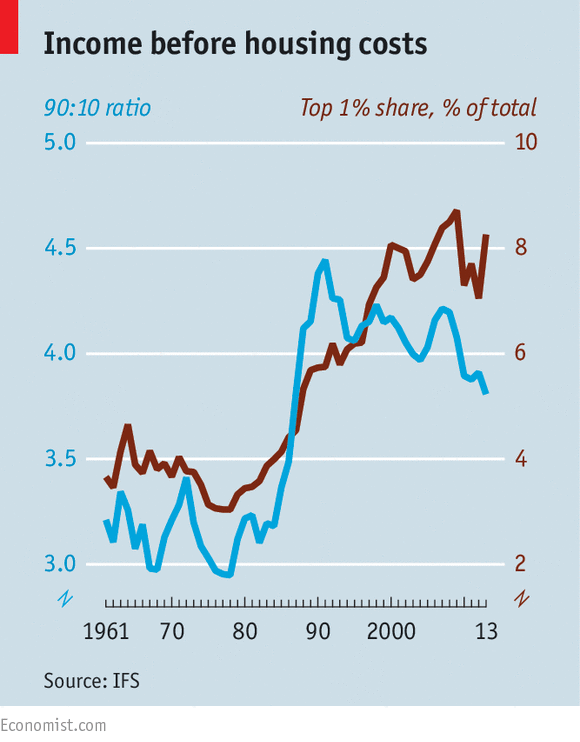
Is inequality rising or falling? Both, according to a report published on July 16th by the Institute for Fiscal Studies, a think-tank. In the 1980s a big gap between rich and poor opened up. Since the early 1990s, however, the difference between the incomes of the top and bottom deciles (the “90:10 ratio”) has diminished; the ratio is now at its lowest in more than 25 years. But that is not the whole story. The share of income held by the richest 1%, another measure of inequality, has continued to grow. The 1% now receive more than double the share they took home 30 years ago. The gap between rich and poor has narrowed. But the gulf between the mega-rich and the rest continues to widen.
Mais

Alemanha 2015

Germany Becomes the World’s Perfect Economy

24/7 Wall St.

Expressão livre

“I may not agree with you, but I will defend to the death your right to make an ass of yourself.”
Oscar Wilde

quarta-feira, 15 de julho de 2015

Idade Media

Book Review: The Middle Ages

Walter Benjamin


Rebelião das massas

"Como as massas não veem nas vantagens da civilização um invento e construção prodigiosos, que só com grandes esforços e cautelas se podem sustentar, creem que seu papel se reduz a exigi-las peremptoriamente, como se fossem direitos nativos. Nas agitações provocadas pela escassez, as massas populares costumam procurar pão, é o meio que empregam costuma ser o de destruir as padarias."
(José Ortega y Gasset, "A rebelião das massas", 1926)

Nimrod

Government Begins

Actually, the state was  indeed first instituted around that time… However, that first government was not created by God at all but, according to Genesis 10:8-10, by a tyrant called Nimrod, who:
“began to be a mighty one in the earth. … the beginning of his kingdom was Babel”
According to Genesis 11, the idea of his followers was to directly challenge God by first instituting a monumental, massive public works project as the focus for a “glorious” centralised society. The “Tower of Babel” was a vain attempt to reach heaven:
“And they said, “Come, let us build ourselves a city, and a tower whose top [is] in the heavens; let us make a name for ourselves, lest we be scattered abroad over the face of the whole earth.”
Nimrod was therefore the first to introduce central planning and to block freedom of movement, expansion and settlement through independent homesteading and private land ownership. In doing so, he set the pattern for governments to follow by deifying themselves and claiming omnipotence over the affairs and labour of others through centralized power.
Josephus, the Jewish/Christian/Roman historian also added some detail. By drawing from ancient tradition and history, he wrote that Nimrod, ...
Mais