terça-feira, 25 de outubro de 2016

As contradições culturais do capitalismo

With a new afterword by the author, this classic analysis of Western liberal capitalist society contends that capitalism—and the culture it creates—harbors the seeds of…
AMAZON.COM

Falta de conhecimento de história

Thomas Jefferson wrote, “History, in general, only informs us what bad…
FEE.ORG|POR ANNIE HOLMQUIST

Heréticos da Idade Média

10 Bizarre Heretics Who Shocked Medieval Europe
Listverse 

Estagnação nos mercados emergentes


Bookmetrix retrieves book and chapter metadata from Springer Nature, Altmetrics and CrossRef, and then aggregates the associated book and chapter metrics from a variety of data sources. Read more
BOOKMETRIX.COM

Dalrymple sobre pobreza e os pobres

    Dalrymple on poverty and about "helping" the poor:
    "The first thing I would say to those who say that we must come and give, otherwise these people are incapable of improving their situation or getting out of their poverty, is to ask them why...Why are these people uniquely unable to get out of their poverty? Is there not evidence, in fact, that when given the opportunity, they do in fact, uh, get out of poverty themselves?" - Theodore Dalrymple, Writer and Psychiatrist (UK)

    "The first thing I would say to those who say that we must come and give, otherwise these people are incapable of improving their situation or getting out of...
    youtube.com

segunda-feira, 24 de outubro de 2016

10 segredo de sucesso de Lemann

Jorge Paulo Lemann - 10 Segredos de Sucesso
https://www.youtube.com/watch?v=vblhuXgoYK8
Ele é nada mais nada menos que o empresário mais bem sucedido do Brasil, considerado em 2015 pela Forbes como a vigésima sexta pessoa mais rica do planeta, liderando alguns dos maiores negócios do mundo.

Eu estou falando de Jorge Paulo Lemann e estes são os seus 10 segredos de sucesso.

1. Aprenda com os erros
2. Invista nos goleiros
3. Aprenda a tomar risco aos poucos
4. Foco é essencial
5. Tenha um sonho grande
6. Procure gente boa
7. Seja eficiente
8. O poder das ideias
9. Desenvolva uma visão de longo prazo
10. Dê sempre o seu melhor

Leia o artigo na integra e ficará a conhecer os 10 Segredos de Sucesso de Jorge Paulo Lemann →http://querosucesso.com/jorge-paulo-l...

Fontes:
https://www.youtube.com/watch?v=OOlna...
https://www.youtube.com/watch?v=o0lMk...
https://www.youtube.com/watch?v=UnnGa...

Quero Sucesso:
Acompanhe o Blog: http://querosucesso.com/blog/
Subscreva a Newsletter: http://querosucesso.com/
Siga-nos no Facebook: https://goo.gl/jKeMf1
Siga-nos no Twitter: https://twitter.com/querosucessobr
Siga-nos no Instagram: https://www.instagram.com/querosucesso/

Roger Scruton sobre Zizek

Parte 2 da excelente crítica do Filósofo Roger Scruton a Zizek e, de certo modo, a toda confusão mental da new left.
"A lengalenga de Žižek serve a um propósito: desviar a atenção do mundo real, das pessoas reais e do raciocínio moral e político comum. Ela existe para promover uma causa única e absoluta, a causa que não admite críticas nem compromissos e que oferece redenção àqueles que a abraçam. E que causa é essa? A resposta está em todas as páginas escritas por Žižek: Nada" ~ Sir Roger Scruton.
O Estado da Arte dá continuidade à publicação do ensaio do filósofo britânico Roger Scruton que avalia o
cultura.estadao.com.br

Pobreza global

Extreme poverty is defined as living at a consumption (or income) level below 1.90 "international $" per day. International $ are adjusted for price differences between…
ourworldindata.org

Novo sistema mundial

Por Ignacio Ramonet
Como é o Novo Sistema Mundial? Quais são suas principais características? Que dinâmicas estão determinando o funcionamento real do nosso planeta? Que características dominarão os próximos 15 anos, de aqui até 2030? Destas questões trata este texto de leitura imprescindível de Ignacio Ramonet, diretor do Le Monde Diplomatique ao sugerir que "precisamos tomar consciência das rápidas evoluções em curso e refletir sobre a possibilidade de que cada um de nós pode intervir de alguma forma".

Competição reduz pobreza

Economic competition in functioning market economies it the best surefire way to reduce global poverty. That, and letting people leave poor countries for rich ones. Learn More...
learnliberty.org/blog/5-ways-ma…

Finanças e desenvolvimento


bookjacket

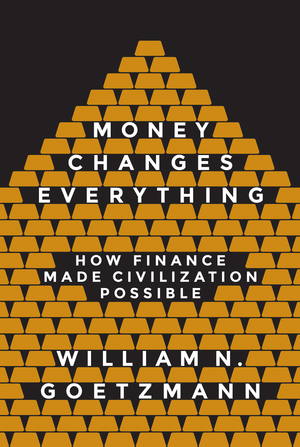
Money Changes Everything:
How Finance Made Civilization Possible

William N. Goetzmann


Hardcover | 2016 | $35.00 | £24.95 | ISBN: 9780691143781
600 pp. | 6 x 9 | 51 halftones. 9 line illus.

eBook | ISBN: 9781400881307 |
Our eBook editions are available from these online vendors
Reviews | Table of Contents
Introduction[PDF] pdf-icon
“[A] magnificent history of money and finance.”--New York Times Book Review

“Convincingly makes the case that finance is a change-maker of change-makers.”--Financial Times

In the aftermath of recent financial crises, it's easy to see finance as a wrecking ball: something that destroys fortunes and jobs, and undermines governments and banks. In Money Changes Everything, leading financial historian William Goetzmann argues the exact opposite—that the development of finance has made the growth of civilizations possible. Goetzmann explains that finance is a time machine, a technology that allows us to move value forward and backward through time; and that this innovation has changed the very way we think about and plan for the future. He shows how finance was present at key moments in history: driving the invention of writing in ancient Mesopotamia, spurring the classical civilizations of Greece and Rome to become great empires, determining the rise and fall of dynasties in imperial China, and underwriting the trade expeditions that led Europeans to the New World. He also demonstrates how the apparatus we associate with a modern economy—stock markets, lines of credit, complex financial products, and international trade—were repeatedly developed, forgotten, and reinvented over the course of human history.

Exploring the critical role of finance over the millennia, and around the world, Goetzmann details how wondrous financial technologies and institutions—money, bonds, banks, corporations, and more—have helped urban centers to expand and cultures to flourish. And it's not done reshaping our lives, as Goetzmann considers the challenges we face in the future, such as how to use the power of finance to care for an aging and expanding population.

Money Changes Everything presents a fascinating look into the way that finance has steered the course of history.

Estudos clássicos

Classical studies are reduced to enclaves in institutions of higher learning, where the idea that some propositions concerning the order of man and society are to be…
theimaginativeconservative.org

Como persuadir

If you want to influence people don't try to persuade them. Use ‘pre-suasion’ instead.

Los Angeles Times Sun, Oct 23

Capitalismo


24.10.2016 – Gedanken zu einem Essay von Ludwig von Mises aus dem Jahr 1951 über „Gewinn und Verlust“ von Antony P. Mueller. Ludwig von Mises (1881-1973) stellte seine Arbeit über „Profit and Loss“ auf der vierten Sitzung der Mont Pelerin Gesellschaft...
MISESDE.ORG

Cálculo econômico no socialismo


Animación que explica el teorema de la imposibilidad del socialismo aplicado a las decisiones de los políticos.
YOUTUBE.COM

domingo, 23 de outubro de 2016

Liberdade de expressão


I cover the language police, the rejection of intellectual diversity, identity politics, micro-aggressions, trigger…
youtube.com

Hillary como ela é

Discriminação


"Nothing has been more common in human history than discrimination against different groups, whether different by race, religion, caste or in innumerable other ways. Moreover, this discrimination has itself been unequal-- more fierce against some groups than others and more pervasive at some periods of history than in others. If there were not so many other powerful factors creating disparities in income and wealth, it might be possible to measure the degree of discriminati...
Continuar lendo
|

Entraves da educação brasileira

Auto-censura

Whether it’s the Holocaust or A Midsummer Night’s Dream, lecturers should not have to tip-toe around issuing trigger warnings to stop students being distressed
THEGUARDIAN.COM|POR FRANK FUREDI

Igualdade econômica

One Of The Five Great Myths Of American Inequality

Forbes 

sábado, 22 de outubro de 2016

Administração pública

"O brasileiro é simples e confiante. A administração pública é que herdou do passado e entronizou em seus regulamentos a centralização, a desconfiança e a complicação. A presunção da desonestidade, além de absurda e injusta, atrasa e encarece a atividade privada e governamental" ~ Ministro Helio Beltrão

Governo

 “Government as such is not only not an evil, but the most necessary and beneficial institution, as without it no lasting social cooperation and no civilization could be developed and preserved” [“The Ultimate Foundation of Economic Science,” 1978 edition, p. 98].

Nikola Tesla

Após 150 anos de seu nascimento, Nikola Tesla atrai toda a atenção que não teve durante sua vida.
HTTP://GOO.GL/DJBDU9

O Império de mil anos

The Real Thousand-Year Reich

The National Interest 

sexta-feira, 21 de outubro de 2016

Religião

Clinton’s revolution against the Catholic Church

BostonGlobe.com 

Eurasia

Eurasia: The World's Largest Market Emerges

Forbes

Desemprego

Why the Incarceration Boom Happened

Justin Fox is a Bloomberg View columnist. He was the editorial director of Harvard Business Review and wrote for Time, Fortune and American Banker. He is the author of “The Myth of the Rational Market.”
Read More.
22
a | A
In 1999, the unemployment rate in the U.S. was just 4.2 percent, compared with 8.6 percent in Germany and 11.3 percent in France. The labor force participation rate (the percentage of the working-age population either with jobs or actively looking for them) was substantially higher in the U.S. than in those countries, too.
The standard explanation that economists offered for this disparity was that U.S. labor markets were less heavily regulated than those in Europe. As sociologists Bruce Western and Katherine Beckett summarized in the American Journal of Sociology in 1999:
In this model, job seeking is intensified by meager state support for the unemployed, and low unionization allows wages to adjust to market conditions. In Europe, institutions introduce inefficiency: large welfare states and strong unions stifle labor demand and reduce work incentives.
Western and Beckett had a different hypothesis. The U.S. had actually engaged in a “sizeable, nonmarket reallocation of labor” in the 1980s and 1990s, they wrote -- by throwing huge numbers of men into prison.
Our central argument is that U.S. incarceration lowers conventional measures of unemployment in the short run by concealing joblessness among able-bodied, working-age men, but it raises unemployment in the long run by damaging the job prospects of ex-convicts after release.
Subsequent labor market developments appear to have borne this out. The U.S. unemployment rate, at 5 percent in September, still looks good -- it’s a little higher than Germany’s, if you go by the harmonized rates that adjust for differences in national unemployment definitions, and a lot lower than France’s. But as has been discussed at great length this election season, this number fails to reflect the fact that millions of Americans have stopped looking for jobs, and thus aren’t counted as unemployed. The U.S. labor force participation rate, among the world’s highest in the 1990s, now lags that of many other wealthy countries.
Mais

Liberdade na universidade

Recent talk at Duke by NYU philosopher Jonathan Haidt. He argues that, at this point, left-wing ideology in universities has become so threatening to their core... mission of truth-seeking, that each individual university must consciously choose: will it be an institution that seeks truth, or will it neglect that mission in favor of trying to change the world according to ideology.
Admittedly, some won't even care what happens to the university: emergent private actors will fill the void if universities continue on their suicide pact. If so, nostalgia aside, good riddance.
Ver mais

On October 6, 2016, Professor Jonathan Haidt gave a Hayek Lecture at Duke. The event was…
youtube.com

Economia evolucionária


Frans de Waal: "We tend to think that the economy was killed by irresponsible risk taking, a lack of regulation or a bubbling housing market, but the problem goes deeper. Those were just the little aeroplanes circling King Kong’s head. The ultimate flaw was the lure of bad biology, which resulted in a gross simplification of human nature. Confusion between how natural selection operates and what kind of creatures it has produced has led to a denial of what binds people together. Society itself has been seen as an illusion. As Margaret Thatcher put it: “There is no such thing as society – there are individual men and women, and there are families.” Archive pick: http://bit.ly/1X7eCLM

The flaws in the competition-is-good-for-you logic